
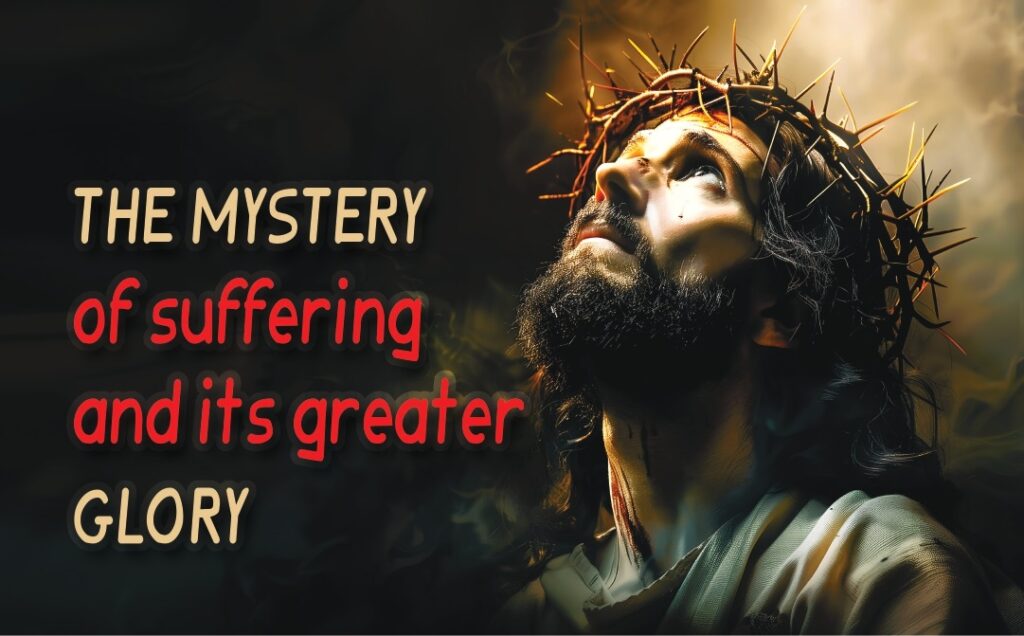
LIKE A SEED’S FRUITFULNESS LIES BEYOND THE MICROSCOPE, THE MEANING OF INNOCENT SUFFERING RESTS UNSEEN UNTIL GOD UNVEILS IT
The reality of suffering in human life
We often reflect on the suffering we experience in life, trying to understand its meaning. In moments of pain and agony, we ask the Lord why we must endure such trials, especially when we have not committed any wrongdoing.
St Peter writes: “For it is of credit to you if, being aware of God, you endure pain while suffering unjustly. If you endure when you are beaten for doing wrong, what credit is that? But if you endure when you do right and suffer for it, you have God’s approval. For to this you have been called, because Christ also suffered for you, leaving you an example, so that you should follow in His steps. ‘He committed no sin, and no deceit was found in His mouth.’ When He was abused, He did not return abuse, when He suffered, He did not threaten; but He entrusted Himself to the one who judges justly. He Himself bore our sins in His body on the cross, so that free from sins, we might live for righteousness; by His wounds you have been healed” (I Pet 2:19-24)
Suffering through sin and innocence
Reflecting on the suffering of Christ, St. Peter teaches that suffering can enter our lives in two ways: through sin or through innocence. The first is easy to understand-when we act wickedly, we reap the consequences of our deeds. Scripture reminds us: “what you sow, you will reap” (Gal 6:7). If someone abuses alcohol and develops liver disease, or smokes and damages their lungs, this is not God’s punishment but the natural result of their choices. Likewise, laziness at work may lead to losing a job, or misuse of marriage and its covenant may bring brokenness. These sufferings are consequences of sin, and the remedy is repentance turning back to God with a sincere decision to change. He can bring good even out of our failures if we return to Him with humility.
The mystery and meaning of innocent suffering
But our deeper concern is innocent suffering the pain that comes without wrongdoing. People who never drank may still suffer liver disease, non-smokers may face lung damage, honest workers may be unjustly dismissed, and faithful couples may remain childless despite never using contraceptives. This kind of suffering cannot be explained by personal fault. St. Peter tells us that when we suffer innocently, we share in the suffering of Christ, who endured agony without committing any evil.
In the Gospel of John, some Greeks, seekers of wisdom from the land of philosophy, approach Jesus with the timeless question of innocent suffering. Jesus answers with a profound image: “Unless a grain of wheat falls into the earth and dies, it remains alone; but if it dies, it bears much fruit” (Jn 12:24). This reveals two truths. First, innocent suffering is never wasted; it will bear fruit and lead to something good. Second, its meaning cannot be fully understood in this life. Just as a seed’s hidden potential cannot be seen under a microscope but only when it dies and grows into a tree, so too the purpose of innocent suffering is hidden until it unfolds in God’s time.
Therefore, when faced with trials we cannot explain whether in family, relationships, or personal struggles we should not waste energy asking “why.” Instead, we trust that God is at work, bringing forth unseen fruit. Innocent suffering, united with Christ’s own,
becomes a mystery that leads to greater glory.
Be wary of false preaching
Scripture makes it clear: innocent suffering has no human explanation. The book of Job illustrates this. Job was righteous, faithfully keeping God’s commandments, yet he lost his wealth, children, and health. His suffering was immense, yet it was not because he disobeyed God. This warns us against false preaching that obedience guarantees worldly prosperity-jobs, houses, cars, or wealth. The Bible never promises such things.
True prosperity, according to Scripture, is not
material gain but the peace and joy that come
from aligning our soul with God’s will. Even
in crisis, this inner peace cannot be taken
away. That is the prosperity God promises: a
life ordered toward Him, filled with joy and
peace that endure beyond worldly troubles. Dwelling on suffering only breeds tension, worry, and bitterness. Jesus teaches us not to waste time seeking explanations for innocent suffering, for such mysteries lie beyond human understanding. Though many claim to explain it in the name of faith or religion, we must not be deceived. God has revealed certain truths, but much remains hidden. Wisdom lies in holding fast to what God has revealed, rather than chasing human inventions or superstitions.
Even the educated can fall into these traps-trusting statues, rings, pendants, or rituals as sources of prosperity or relief. Yet such prosperity does not come from God. Temporary testimonies often collapse into deeper troubles, and many exploit this deception for money. Without grounding in the Church’s teaching, it is easy to be misled.
The power of asking the right question
Asking a question does not prove intelligence-anyone can ask, whether wise or foolish. What matters is what kind of question we ask. A right question leads to an answer; a wrong one leads nowhere. This is how science advances: by learning to ask the right question. When facing innocent suffering, the right question is not “Why am I suffering?” but “How can I endure this suffering without losing peace and joy?” The Bible gives us the answer: Look to Jesus Christ.
Looking to Jesus
The letter to the Hebrews teaches us to look to Jesus, the “Pioneer and Perfecter of our faith” (Heb 12:2) who endured the cross for the joy set before Him. His focus was not on the pain but on the reward the joy of sitting at the right hand of the Father. In the same way, if our eyes are fixed on the eternal reward, suffering becomes bearable.
The true reward
This reward is not material wealth or comfort. Jesus promises only one thing: eternal life, He does not promise jobs, money, or ease, but everlasting life with Him. When our focus is on this eternal joy, earthly pain loses its power.
Applying the principle
If asked to kneel for five minutes, pain may stop us. But if promised a great reward, we endure despite discomfort. Again a small salary brings complaints, but a large salary makes us endure long hours without grumbling. The reward changes our perspective. In the material world, rewards help us endure hardship. Scripture uses this same principle: if our minds are fixed on the eternal reward of heaven, we can endure suffering gracefully, just as Jesus did.
The passion of Jesus and the call to focus on heaven
When we read the Gospels, we see Jesus carrying His cross to Calvary. He does not curse, complain, or speak harshly. Instead, He bears His suffering with serenity, like a lamb led to slaughter. Though the pain is excruciating, His silence is filled with grace. If we desire that same peace and joy, Scripture gives us the key: “Set your minds on things above, not on earthly things” (Col 3:2). Our trouble is that we fix our eyes on earthly rewards, which makes us restless and easily disturbed. The Word of God calls us to shift our focus heavenward. When our hope is in the reward from above, even the crosses of daily life misunderstanding spouses, disobedient children, difficult in-laws, or unkind friends-lose their power to shake us.
A priest’s encounter
A priest once shared an experience from his ministry. In a new parish, he visited homes to understand the struggles of his flock and bring their burdens into prayer. At one house, he met a bedridden man cared for by his wife. She worked tirelessly earning, cooking, bathing, and feeding him. Yet, instead of gratitude, the man accused her of infidelity, though he had no proof, only suspicion. The priest was shocked. He looked at the wife, expecting her to defend herself. But she remained silent, calm, and dignified. Later, she told the priest: “Father, do not worry about me. I do this because I know my reward is in heaven. I am not seeking earthly praise or comfort. My Lord will give me eternal joy.” That day, the priest’s eyes were opened. He realized that true faith is not only professed but lived. While many recite the Creed “I believe in the resurrection. I believe in life everlasting” their actions often betray the very faith they profess. Yet here was a woman whose life reflected her belief.
The eternal perspective
St Paul writes: “I consider that our present sufferings are not worth comparing with the glory that will be revealed in us” (Rom 8:18). This woman embodied that truth. Her eyes were fixed on heaven, so her suffering did not overwhelm her. We must remember: life here is temporary-perhaps one hundred years at most. Beyond that lies eternity: heaven or hell. These are not abstract ideas but realities taught by Jesus Himself. If our gaze is fixed on eternal life, no earthly trial can rob us of joy. Even in crisis, we will know the peace of the Lord.