


It is so easy for one to get lost in the hectic routines and endless challenges of life. If we do not pause to do some soul-searching, every now and then, we could get overwhelmed by disappointments, irritation and sadness. In the busyness of life, as it is on the city highways where we are navigating difficult roads and crazy traffic, we shout at others, and get shouted at by others. We could end our day tired, guilty, regretful, even wondering if we have wasted our life on the wrong track. It is so necessary, to prayerfully ask ourselves a few basic questions beginning with, “What am I living for?” “Am I happy with the way I am living?”
“All who are called by my name, I created for my glory” (Is 43:7) The word of God is crucial to understanding life. At the Last Supper, the Lord speaking to the apostles offers a precious revelation: “You did not choose me, but I chose you and appointed you so that you might go and bear fruit-fruit that will last” (Jn 15:16). Jesus is speaking about a choice, one that is made by God, when it comes to the lives of His disciples. A disciple is one who has received an appointment, or rather a call, to accomplish a goal. That goal is to bear “fruit that will last.” This truth holds good for everyone who follows Jesus. We are not on this earth by chance or by accident. We were called into existence by God, for He has appointed us for one purpose – to bear fruit. This fruit alone gives meaning to life. One may wonder what this fruit is. The answer is the fruit of the Holy Spirit. The moment one chooses to follow Jesus, we realize that that choice was in truth not ours, but the Lord’s. As St John writes, “We love because He first loved us” (I Jn 4:19). Scripture further reveals this choice was made even before the foundations of the world (Eph 1:4). The fruit of our life was predestined. “For weare God’s handiwork, created in Christ Jesus to do good works, which God prepared in advance for us to do” (Eph 2:10).
By human standards, we evaluate the works of a person by the number and magnitude of worldly achievements. God however, sets
one standard before us the bearing of the fruit of the Holy Spirit. St Paul enlightens us with this listing: “The fruit of the Holy Spirit is love, joy, peace, patience, kindness, generosity, faithfulness, gentleness and self-control” (Gal 5:22,23). These qualities are called as “fruits” because they are the manifestations of the presence and power of the Holy Spirit. When there are apples on a tree, we would call that tree as an apple tree. An apple tree can only produce apples. Apples are the manifestations of an apple tree. So also, when the disciples of Jesus are anointed with the Holy Spirit, the fruit of the Spirit will be manifested in their lives.
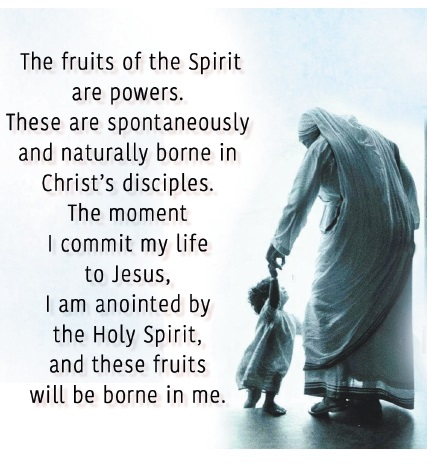
The fruits of the Spirit are, in fact, powers. These are spontaneously and naturally
borne in Christ’s disciples. The moment I commit my life to Jesus, I am anointed by the Holy Spirit, and these fruits will be borne in me.
The Lord explains that we must be united with Him, for the fruit to be borne in our lives. Jesus said, “I am the vine; you are the branches. If you remain in me and I in you, you will bear much fruit” (Jn 15:5). When we become one with Christ, He abides in us. In that oneness, the Holy Spirit will flow into us, just as the life-sap flows from the main stem of the vine into its branches. It is then that the branches bear fruit. The Holy Spirit will be manifested in us by the abilities of love, joy, peace, gentleness, kindness and self-control. These are the supernatural manifestation of the powers of the Holy Spirit. To reach this goal where the Holy Spirit’s nature shines through us, we must be united with Jesus. This happens when we are surrendered to the Lord, at every moment of our lives
“A tree is known by its fruit (Mt 12:33)
Love in our hearts is manifested on our faces through the smile. If however, there is no love or joy in our hearts, we would be hypocrites. Feigning love is hypocrisy. When love is genuine, the smile emerges spontaneously. So also, the gentleness, kindness, and joy that we share in our relationships must be a very natural flowing out of the Holy Spirit in our hearts.
I remember visiting a distant parish to celebrate the evening Mass as the parish priest was not in town. Since I reached after a long journey, I was taken to the dining hall and given a cup of tea. There were two apples in a basket on the dining table. Being tired, I picked an apple to eat. When I bit into it, I realized it was of wax. It looked colourful, and attractive, but was a mere exhibit. I was irritated, though it was my fault in not being observant. Today, there are many such pieces of exhibition. We may look to them as a priest, a teacher, a doctor, a parent. I may don a
Roman collar, or a stethoscope, or a title of being a parent. If I am not anointed with the Holy Spirit, I will instead of blessing others, become an irritation. The smile on my face will not be a spontaneous manifestation of love. The joy will not be the fruit of the Holy Spirit. It will be a drama. I am not happy to meet you, but I just make pretence of it. Pretensions don’t
last. Soon people would come to see through the charade.
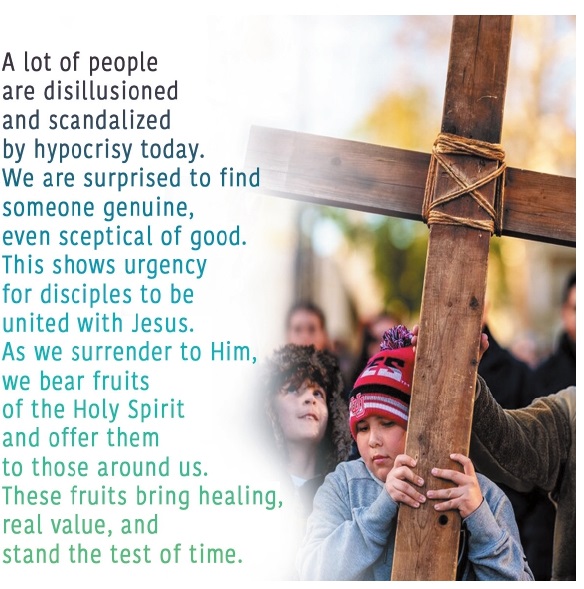
A lot of people are disillusioned and scandalized by the prevalence of hypocrisy today. Perhaps, we are so familiarised with pretensions, that we have become scandal-proof! We are surprised to find someone genuine, and are even sceptical of any good.
This underlines why there is urgency for the disciples to be united with Jesus. As we surrender our lives to Him, we will bear the fruits of the Holy Spirit, and can offer it to those around us. It is these fruits alone that bring healing, are of real value, and can stand the test of time. So we shall fulfil our God-given mission in life. If we fail to accomplish this, our lives will be wasted.
“Behold, I stand at the door and knock” (Rev 3:20)
We often imagine we have made it in life when we are successful in a profession. There is a difference between a profession and a mission. Each person can choose their profession. One may work as an accountant, or as a sales-person. For around eight hours a day they are at their workspace. An accountant is paid to write accounts. A sales-person is paid to smile and convince people to purchase a product. I am a priest. You could be a husband, a wife, a doctor, a teacher. What we are given is a mission. There is a world of difference between this and a profession. A mission, unlike in the case of a job, is given by the Lord, and is to be a continuation of the ministry of Jesus. We can exercise this mission only as we bear the fruit of Holy Spirit. St Mark relates in the gospel an event that has evoked a lot of questions – Jesus cursing a fig tree. The scripture reads this way, “As they were leaving Bethany, Jesus was hungry. Seeing in the distance a fig tree in leaf, He went to find out if it had any fruit. When He reached it, He found nothing but leaves, because it was not the season for figs. Then He said to the tree, “May no one ever eat fruit from you again.” And His disciples heard Him say it… In
the morning, as they went along, they saw the fig tree withered from the roots. Peter remembered and said to Jesus, ‘Rabbi, look! The fig tree you cursed has withered!” (Mk 11:12-14, 20,21). Jesus is hungry and looking for fruits. The evangelist informs us that it was not the season for fruit-bearing. Despite knowing this, the Lord curses that fig tree and it withers. One might wonder why Jesus would be
so hard. Scripture scholars, in fact inform us that this is ‘action prophesy’. The event is a warning to every one of us.
As Jesus approached the fig tree, He comes to each of us, hungering for fruit. As a priest, I have been called to bear fruit in my mission. When people approach me, as a missionary I must offer them the fruit of love, joy, peace, gentleness, kindness. When someone comes to me distressed, I cannot dismiss them citing that I am busy. It is Christ who comes to me in the sad, distressed, sinful persons. If I am too busy to serve them, there will be a curse on me, and I will wither away. If certain circles in the Church are withering away today, it is because the hungry Jesus was met with rejection far too often.
You may be a parent reading this. Your son comes yelling at you. You cannot shout back, and claim “I am the parent. How can you shout at me?” In that son, you need to recognize Jesus, hungry to be understood. Your son has a problem, and in that unpleasant manner he is expressing his own dissatisfaction with the whole world. Perhaps he has completed his education, but is not getting a job. He has gone knocking door-to-door. All his companions have got a placement somewhere. He has begun to doubt his future. Will he ever get a job? Who can answer him? How can he shout at a stranger? He can only turn to his parent. Jesus is coming to you in him, hungry and reaching out for the fruit of love and gentleness. You cannot reject him. You must make the time for him, listen to his ranting, and give him the fruit of understanding. If you shout back at him, you have lost him. Your family will wither away. If your son slips further into desperation, or leaves the house; who will be responsible? Your daughter could be sitting in a corner depressed. You cannot say, “Why are you sitting there depressed? Come and help in the kitchen. Do some work.” She may have gone for an interview the previous day. She could not answer all the questions. She is feeling defeated. She is not able to express this to anyone. As a parent, you must go and sit by her side, and get conversing with her. Maybe she will not talk to you for half an hour. Sit with her holding her hand for half an hour. Be generous with your time. She would want to lean on to your shoulder and cry. You have gained your daughter. You have satisfied Jesus who is hungry.
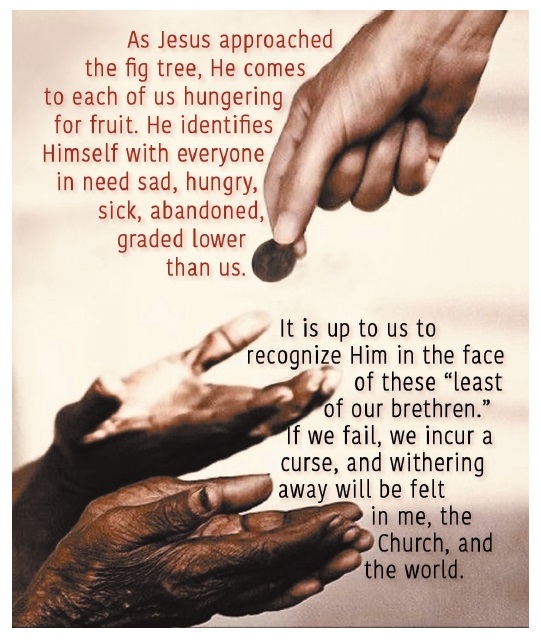
At the Final Judgment, the righteous were those to whom the Lord would say, “I was hungry and you fed me” (Mat 25:35). Describing this crucial moment, Jesus mentions that the righteous would ask, “Lord, when did we see you hungry and feed you?” (Mat 25:37). The King responds, “Whatever you did for one of the least of these brothers and sisters of mine, you did for me” (v. 40). Jesus identifies Himself with everyone in need, sad, hungry, sick, abandoned, everyone graded lower than us in the social scale. It is up to us to recognize Jesus in the face of every one of these “least of our
brethren.” If we fail to do so, we incur a curse, and the experience of withering away will be felt in me, in the Church, and the world around.
“Overcome evil with good” (Rom 12:21)
There is a danger associated with failing to bear the fruit of the Holy Spirit. St. Paul in the same passage where he lists out the fruit of the Spirit, warns us of being governed by the works of the flesh (Gal 5:19-21). As disciples of Jesus, we are to wait upon God for the anointing of the Holy Spirit, whereby we are filled with the fruits of the Holy Spirit. If we fail to do so, there is the dark consequence that we will manifest the works of the flesh. The teaching is clear: “Now the works of the flesh are obvious; immorality, impurity, licentiousness, idolatry, sorcery, hatred, rivalry, jealousy, outbursts of fury, acts of selfishness, dissensions, factions, occasions of envy, drinking, bouts, orgies and the likes. I warn you as I warned you before, those who do such things will not inherit the Kingdom of God” (Gal 5:19-21). If we are not anointed with the Holy Spirit, such negativities will enter into our hearts. For when our lives are unguarded by the Holy Spirit, the flesh will defeat us.
“Love is the fulfilment of the law” (Rom 13:10)
Something extraordinarily beautiful happened when the Holy Spirit descended upon the disciples of Jesus. The fruit of the Holy Spirit was manifested in a fabulous manner. The Acts of the Apostles describes the life of the early Church: “The community of believers was of one heart and mind, and no one claimed that
any of his possessions was his own, but they had everything in common. With great power the apostles bore witness to the resurrection of the Lord Jesus, and great favour was accorded them all. There was no needy person among them, for those who owned property or houses would sell them, bring the proceeds of the sale, and put them at the feet of the apostles, and they were distributed to each according to need” (Acts 4:32-35). It is interesting that while St Paul is listing out the many qualities of the anointing, he describes these not as the “fruits” but in the singular as the “fruit” of the Holy Spirit. We understand that the fruit of the Holy Spirit is love. The Lord had taught, “This is how all will know that you are my disciples, if you have love for one another” (Jn 13:35). In that famous thirteenth chapter of his letter to
the Corinthians, St. Paul illustrates how from that one fruit of love, every other fruit follows. “Love is patient, love is kind… It bears all things, believes all things, hopes all things, endures all things” (1 Cor 13:4-7). Every quality listed as the fruit of the Holy Spirit is in fact the manifestation of the one fruit that is love. This love was the most obvious aspect of the life of the early Church. “There was no one in need.” If in our communities and families, there is anyone in need; it is the sign of the depletion of the Holy Spirit. Every person in need is God’s call to us to rise from our selfish ways, and in fact to go out of our way, and spend ourselves on the other. We need to be filled with so much of love that we may forget ourselves, seeking to meet the need of the other. This is what the Holy Spirit will enable us to do. The key to this empowerment is clearly surrender. As we surrender ourselves to Jesus, our hearts are opened for the Holy Spirit to fill us. “The love of God has been poured out into our hearts through the holy Spirit that has been given to us” (Rom 5:5). With this love, we shall fulfil Christ’s mission in the world today.
Prayer
Lord, you have trusted me with a great mission. There is no meaning or goodness in life, unless I fulfil this great call to love. I shall, day after day, surrender to you, my Lord Jesus. As you anoint me with your Holy Spirit, I shall live in the power of love. Through the fruit of the Spirit, may my life quench your thirst, and bring consolation to those around me. Amen