

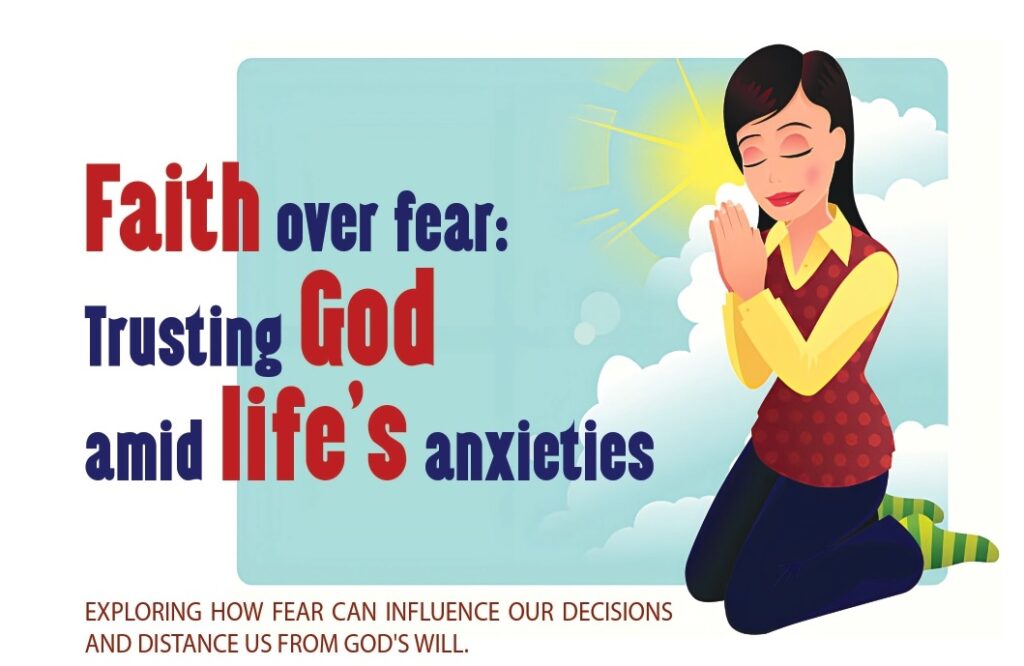
EXPLORING HOW FEAR CAN INFLUENCE OUR DECISIONS AND DISTANCE US FROM GOD’S WILL.
H uman life is often marked by a multitude of fears some rational. others deeply rooted in insecurity or societal pressure. When we enter into the presence of the Lord, one of the most transformative prayers we can offer is to ask Him to reveal the principal fear that misguides our decisions and leads us away from His will. Scripture, particularly the Psalms, teaches us that fear can be a gateway to evil when it is misplaced or misunderstood. Jesus Himself cautioned against fearing those who can harm only the body, urging instead a reverent fear of the One who holds authority over both body and soul (cf. Mt10:28).
Fear’s Role in Moral Compromise
Many individuals live in a state of chronic anxiety, fearing loss, rejection, or societal judgment. This fear often robs them of peace and joy, and tragically, can lead to
Rev Fr Jacob Arimpur VC
sinful choices. Jesus repeatedly exhorted His followers: “Do not let your hearts be troubled. Believe in God, believe also in me” (Jn14:1). When fear dominates our hearts, it distorts our moral compass and leads us astray.
A poignant example comes from a couple who shared their story. In their forties, already parents to three grown children, they discovered they were expecting another child. Rather than rejoicing in this unexpected gift of life, they were consumedby fear fear of societal ridicule, fear of their children’s judgment, fear of being misunderstood. This fear became so overwhelming that they chose to terminate the pregnancy. Their story reveals how fear, when unchecked, can lead to grievous decisions that contradict the sanctity of life.
or This narrative is not isolated. Many couples today, even within the sacrament of marriage, are hesitant to welcome children due to concerns about financial stability, societal expectations, personal convenience. Such fears often manifest in the use of contraceptives, which, according to the teachings of the Catholic Church, contradict the divine covenant of marriage. The Church teaches that openness to life is integral to the marital vocation, and any deliberate obstruction of this openness stands in opposition to God’s design.
At the heart of contraceptive use often lies fear fears of the future, fear of inadequacy, fear of the unknown. But this fear also reveals a deeper spiritual issue: a lack of trust in God’s providence. Jesus addressed this in the Gospel of Matthew, pointing to the birds of the air and the lilies of the field. They neither sow nor reap, yet the Father cares for them abundantly. “If God so clothes the grass of the field… will He not much more clothe you, O you of little faith?” (Mt 6:30).
Fear often leads us into sin. A young woman once admitted that she engaged in fornication because she feared losing her boyfriend. This is a common struggle many compromise their values out of fear of rejection,
loneliness, or societal pressure. Others fear aging, spending excessive time and resources to conceal it. Still others fear financial insecurity, especially in times of unemployment. These fears are real, but they need not dominate us.
Trusting in Divine Providence and care
Faith calls us to trust that God, the Author of life, will also be its Sustainer. Couples are not creators of life; they are instruments through whom God works. The existence of childless couples despite medical normalcy-underscores the truth that life is ultimately a divine gift, not a human guarantee. If God permits life to enter the world, He also provides the means to nurture it. The Psalmist affirms this: “He provides for His beloved even as they sleep” (Ps127:2) This assurance invites. believers to rest in God’s care, confident that He is actively working for their good even in moments of vulnerability or uncertainty.
Fear, then, is not merely an emotional response; it is a spiritual indicator. Persistent fear often signals a deficiency in faith. Even devout practices daily prayer, sacramental participation, devotion to the Rosary-can coexist with a heart that struggles to trust. Thus, we must continually ask the Lord to reveal and heal the fears that dominate our lives.
Christ’s Peace Overcomes Fear
Jesus offers a peace that surpasses worldly understanding a peace rooted in His presence and promise. “Peace I leave with you; my peace I give to you. Not as the world gives do I give to you” (Jn 14:27). When Christ dwells within us, fear loses its grip, and peace becomes our abiding reality.
When Christ reigns in our hearts, we receive peace, strength, and courage. Fear and anxiety lose their grip when we truly believe in the power of the resurrection. This is not mere sentiment it is a transformative reality. The life of Saint Paul exemplifies this truth. In Iconium, after preaching Christ crucified, Paul was stoned, dragged out of the city like a lifeless body, and left for dead. Yet, when the disciples gathered around him, he rose-not only physically, but spiritually empowered. Remarkably, he returned to the very town that rejected him, undeterred and fearless (Acts 14:19,20). Such boldness is the fruit of faith in the Resurrection.
To follow Jesus is to embrace courage. True faith is tested not in comfort, but in adversity. It is in moments of pressure and hostility that the depth of our trust in God is revealed.A testimony illustrates this beautifully. A young woman, diagnosed with uterine cancer, was advised by her doctor to conceive a child with her boyfriend before undergoing surgery. She refused, citing her Catholic faith and moral convictions. Her decision shocked the doctor, accustomed to a culture where such choices are normalized. She and her mother attended a retreat, seeking strength in prayer rather than surrendering to fear and moral compromise. Later, she was miraculously healed, married, and gave birth to a child. Her courage, rooted in faith, triumphed over fear and illness.
Surrendering fear to the Lord to grow in His power
Let us therefore bring our fears before the Lord. Whether fear of loss, aging, or uncertainty about the future, we are called
to surrender them in faith. If we are doing our part seeking, working, praying-God will provide. History bears witness: it is not human strength, but divine providence that sustains humanity.
St. Catherine of Siena, the twenty-second child of a poor cloth dyer, was born into poverty but not into fear. Her parents, though materially lacking, trusted deeply in God’s providence. Despite their limited means, all their children were cared for, and Catherine, though illiterate, became one of the Church’s greatest mystics. Her spiritual authority was so profound that even Pope Gregory XI heeded her call to return to Rome during a time of crisis. Her life testifies that true power comes not from education or status, but from surrender to God.
Similarly, Dr. A.P.J. Abdul Kalam rose from humble beginnings to become a renowned scientist and President of India. His family lacked wealth, yet through perseverance and divine grace, he achieved greatness. These lives remind us: it is not worldly resources but God’s hand that sustains and elevates those who trust in Him.
Today, many parents fear for their children’s future marriage, health, finances. But fear achieves nothing. Our role is to act faithfully search for alliances, seek medical help, pray-and leave the rest to God. Anxiety only worsens illness and clouds judgment. In every trial be it sickness, uncertainty, or delay-our peace lies in trusting the Lord. He never acts for our harm, only for our good. Let us do our part and rest in His providence, knowing that His peace surpasses all understanding.