
To truly learn how to break free from sin or guard against slipping back, we must first uncover the path that leads into it. Only when we grasp the way sin takes root in our lives-and are convinced of how that process unfolds can we begin to understand the way out and walk toward freedom.
Sin is a choice and not forced or an accident
From the Old Testament to the New, one truth rings clear: sin does not happen by accident. No one commits sin by chance, and no one is forced into it. From the very first book of the Bible, Genesis, Scripture repeats that sin is the conscious decision of a human being.
If I lie, it is not because lying has somehow become automatic. It is because I have chosen to lie. If I lose my temper and unleash abusive words or even violence, I cannot say, “They provoked me.” The reality is simpler: I wanted to respond that way, and I did. The devil cannot compel me. He can only tempt, suggest, or advise. But the decision is mine. Consider Adam and Eve. Many say the devil “made” them sin, but if we read carefully, we see otherwise. “So when the woman saw that the tree was good for food, and that it was a delight to the eyes, and that the tree was to be desired to make one wise, she took of its fruit and ate; and she also gave some to her husband who was with her, and he ate” (Gen 3:6). Notice: the serpent did not pluck the fruit, did not force Eve’s hand, and did not push it into her mouth. Eve walked to the tree, plucked the fruit. Eve ate. Then she offered it to Adam, who freely chose to eat. Their sin was not imposed; it was embraced.
Before this, God had already spoken clearly: “You must not eat from the tree of the knowledge of good and evil” (Gen 2:17). Yet God did not force obedience. He gave the command, but He left them free. Even when Eve reached for the fruit, God could have stopped her but He did not. That is the mystery of divine love: God instructs, warns, and guides, but He does not override human will.
So let us understand: every sin-whether anger, deceit, lust, or rebellion is born of our own decision. The devil may tempt, but he cannot force. God always warns us, but He will not coerce. The responsibility is ours.
Why do we sin? The answer simply put is because we choose to.
In the timeless parable Jesus shares in Luke 15-the story of the prodigal son is a shining example of that truth. In the parable we read that the father has two sons. The younger, restless and ambitious, demands his share of the inheritance. The father, with patience and love, grants it. The son departs, pockets full of wealth, heart full of reckless desire. He squanders everything-
lavish parties, indulgence, sins of every kind. Soon, the gold is gone, the friends vanish, and he finds himself in the filth of a pigsty, feeding swine to survive.
Now pause and ask: who sent him there? Did his father drive him away? No. The father never forced him out. It was the son’s choice his free will; his decision to leave, to waste and to sin. No one compelled him to lie with prostitutes or to throw away his fortune. He chose, and his choices carried consequences.
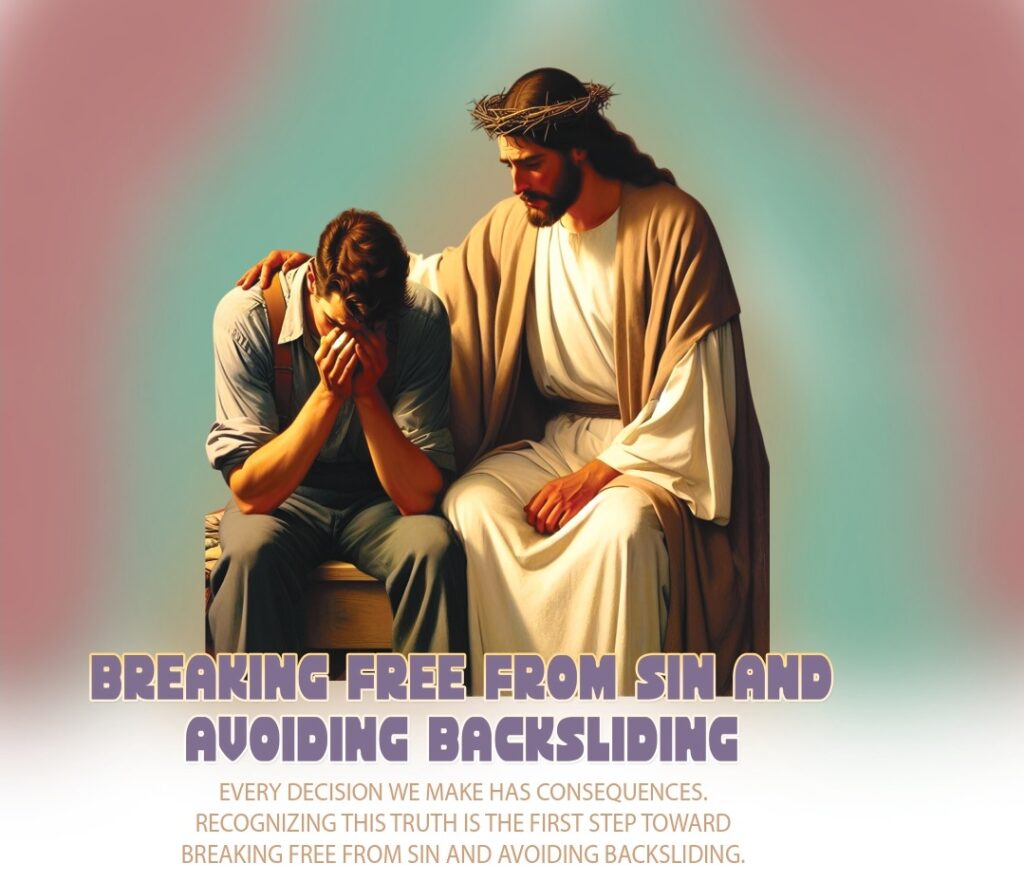
The consistent message therefore of both the Old and New Testaments is this: Sin is not accidental. Sin is not forced. Sin is the result of free will. We commit sin because we want to commit sin. And every decision we make has consequences. Recognizing this truth is the first step toward breaking free from sin and avoiding backsliding.
Breaking Free from Sin: Decision and Action
Ayn Rand, the Russian-born American author, once wrote: “We can ignore reality, but we cannot ignore the consequences of ignoring reality.”This statement is deeply thought-provoking. Ignoring reality is a choice, but the consequences of that choice are unavoidable. For example, if there is fire in front of you, you may choose to ignore it. But if you walk into it, you cannot escape the consequence you will be burned. This is exactly what happens in the parable of the prodigal son (Luke 15). He chose to leave his father’s house. That was his decision. But the consequence was misery he ended up in a pigsty. Yet, Jesus reveals something beautiful: the way out of sin is not just realization, but decision and action. Jesus says: “But when he came to his senses, he said, “How many of my father’s hired hands have bread enough and to spare, but here I am dying of hunger! I will get up and go to my father, and I will say to him, Father, I have sinned against heaven and before you” (Lk 15:17-18). The prodigal son did not stop at realization. He made a decision: “I will get up and go to my father.” And he acted on it. That is what brought change. Realization alone does not transform us. Many of us realize our sins-lying, gossiping, lust, slander-but realization without action leaves us stuck.
The Call to Choose and Change
Scripture says: “If you choose, you can keep the commandments. And to act faithfully is a matter of your choice. He has placed before you fire and water; stretch out your hand for whichever you choose. Before each person are life and death, and whichever one chooses will be given” (Sir 15:15-17). This shows that sin is not forced upon us. We remain in sin because we choose to. The prodigal son could have stayed in the pigsty forever, but he chose to act. Likewise, we must choose and act if we want freedom. Jesus tells the woman caught in adultery: “Neither do I condemn you. Go your way, and from now on, do not sin again” (Jn 8:11). Notice that Jesus does not say, “You are human, so you will keep repeating sin.” Instead, He commands: “Do not sin again.” This means change is possible. Jesus knows our sinful nature, but He also knows we can overcome it if we decide and act.
Strength through Christ
St Paul declares: “I can do all things through Him who strengthens me” (Phil 4:13). This is the voice of the Holy Spirit. No matter how strong our addictions or sinful habits, God has already given us the grace to overcome. The only barrier is our unwillingness to decide and act. The devil whispers lies, telling us that change will happen magically or that sin is inevitable. But Scripture teaches otherwise. Realization is only the beginning. True transformation comes when we decide and act. Like the prodigal son, we must rise
from the pigsty, walk back to the Father, and believe: “I can do all things through Him who strengthens me” (Phil 4:13).
In another testimony from the Bible, We read about Zacchaeus, a sinful man who was the chief tax collector. He was greedy for money, cheating and deceiving people for years.
One day, Zacchaeus wanted to see Jesus. Being short, he ran ahead of the crowd and climbed a sycamore tree. Jesus saw him there and said, “Come down, I want to come to your house.” Jesus went with him, but notice-He did not immediately offer salvation at the tree. At Zacchaeus’ house, they ate and talked. Finally, Zacchaeus made a bold decision. He said: “Look, Lord, I give half of my possessions to the poor. And if I have cheated anyone, I will pay back four times as much.” Jesus replied, “Today salvation has come to this house, because he too is a son of Abraham. For the Son of Man came to seek and to save the lost” (Lk 19:8-10).
This shows us something important: Jesus waits for our cooperation. Salvation came when Zacchaeus decided to act. He did not say, “I will try.” He said, “I will do it.” Many people today say, “With your grace, Lord, I will try not to sin again.” But true grace means action, not trying. Saying “I will try” often reveals that we are not fully ready to give up sin. Zacchaeus did not leave a loophole he made a firm decision.
The Holy Spirit reminds us: when a person truly decides to give up sin, nothing-not even the devil can stop them. If we confess but keep repeating the same sins, it shows we have not yet decided to let go. The moment we decide and act, we are free.
Think of the prodigal son. Think of Zacchaeus. The Bible is full of such examples.Let us ponder this truth deeply and receive the grace to act upon it seeking the intercession of our blessed Mother Mary.