
The Double Portion Anointing-II The Bethel Experience
 Rev Dr Augustine Vallooran VC
B efore the Lord Jesus ascended to the heavens, He asked the disciples to persist in prayer to receive the Holy Spirit, “Wait for the promise of the Father” (Acts 1:4). They waited with Mother Mary in the upper room (Acts 1:14). On the day of Pentecost, they all were anointed with the Holy Spirit. This is the model for all Christians, and for the Church communities to pray for a fresh anointing of the Holy Spirit. When the Lord gives us the grace to experience that anointing in a powerful way, our Christian commitment becomes relevant in our circumstances, and we can fulfil our mission in a meaningful manner.
[/read more]
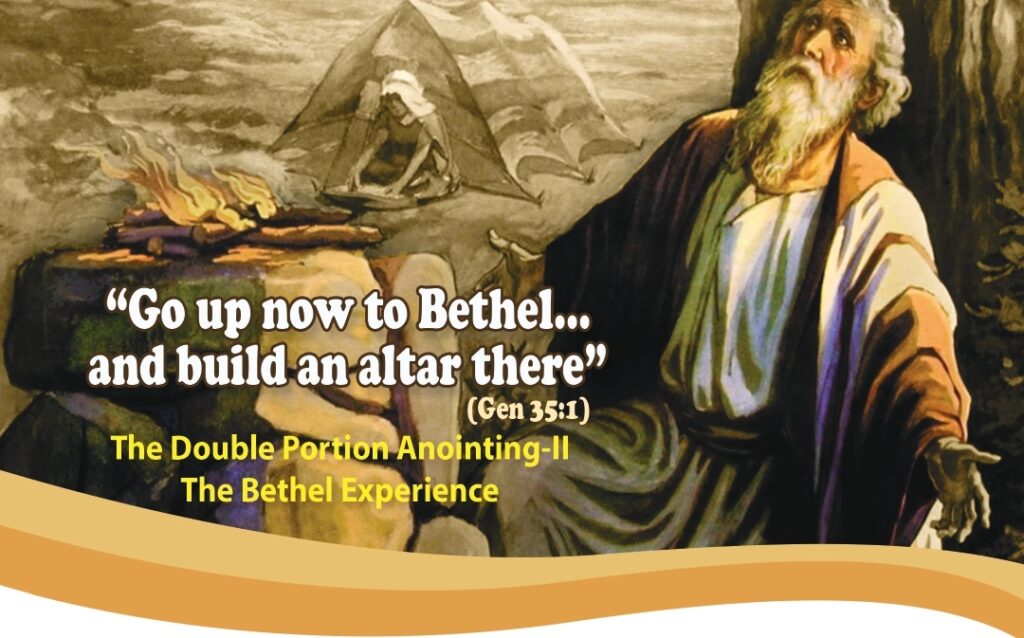
“The Lord has sent me on to Bethel” (II Kgs 2:2)
We meditate on the pursuit of such anointing that Elisha seeks to receive, with the guidance of the powerful prophet Elijah. The scripture narrates, “When the Lord was about to take Elijah up to heaven in a whirlwind, he and Elisha were on their way from Gilgal. Elijah said to Elisha, “Stay here,please. The Lord has sent me on to Bethel. “Elisha replied, “”As the Lord lives, and as you yourself live, I will not leave you. So they went down to Bethel” (II Kgs 2:1,2).
This moment is the continuation of the pilgrimage initiated at Gilgal, with the prayer of Elisha to the prophet Elijah, to bless him with the double measure of the spirit.
Gilgal evoked great spiritual memories for Israelites. It was the first stage in the journey of Israelites from Egypt, the land of slavery to the Promised Land. That is where the reproach of Egypt was rolled away from the hearts of Israelites. The reproach of Egypt referred to the
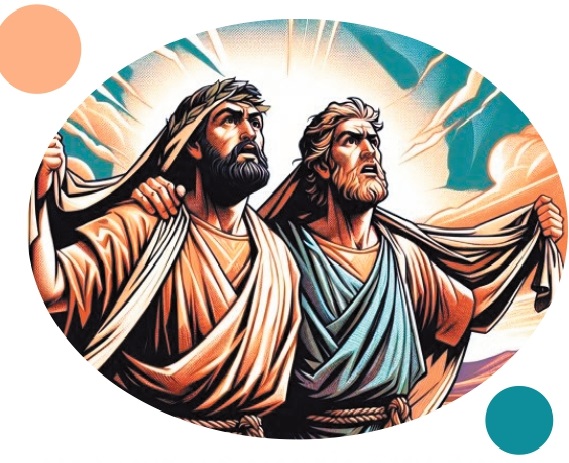
GOD’S LOVE AND CARE FOR THEM EVOKED PRAISE, AND REMAINED TO STIR THEIR FAITH FOR GENERATIONS. ELIJAH BRINGS ELISHA TO GILGAL PRECISELY TO AWAKEN IN HIM THE HEALING MEMORY OF FAITH IN GOD.
shame engraved in their hearts, being identified as the nation of slaves in Egypt. Gilgal was where God bestowed on them an inner healing, to put it in a modern idiom. By intervening in a
mighty way on their behalf, and by working wondrous miracles to take them out of Egypt, God revealed how precious they were to Him. From that experience at Gilgal, the memories of their slavery in Egypt were not associated with shame. When they considered the four generations of their life in Egypt, there was no regret or anger. Egypt remained a testimony of the choicest love that God had for them, and of His powerful intervention with a mighty arm. Those great memories of God’s love and care for them evoked praise, and remained to stir their faith for generations. Elijah brings Elisha to Gilgal precisely to awaken in Him the healing memory of faith in God.
“Purify yourselves and change your garments” (Gen 35:2)
From Gilgal, Elijah takes Elisha now to Bethel, for a second stage in this journey of spiritual preparation.
In the memory of Israel, Bethel is counted as the sacred place of sacrifice. Here Jacob offered the great sacrifice to God. It is Jacob who is named by God as Israel, and this name is given to the entire chosen people of God. This happened way before the Egyptian travail.
It is a long journey that Jacob would make to reach Bethel. It was not easy for Jacob to make that sacrifice to God. Jacob was
a man of self-righteousness. We need to dwell on the journey of the patriarchs in scripture to understand Jacob’s sacrifice.
God chose to be referred to as the God of Abraham, Isaac, and Jacob (Exd 3:6, 15; Mt 22:32, Acts 7:32). Now, this title where God identifies Himself by the three patriarchs comes from the covenant God made with Abraham a covenant renewed with Isaac and Jacob (Gen 50:24).
Before Jacob, God was known as the God of Abraham and the God of Isaac (Gen 28:13). The first covenant God chose to make with Abraham, the father of all believers. With this covenant, the wandering tribe of Israel is elevated by the promise of prosperous land and plentiful descendants. After Abraham died, the covenant was renewed with Isaac, the only son of Abraham. In the mind of Jacob there was the insecurity about what happens after Isaac. It was assumed that by birthright, Esau, the elder son of Jacob would inherit the covenant. Therefore, God would be referred to as the God of Abraham, Isaac, and Esau. This was the natural assumption. Of course, in the mind of God, it was clear that Jacob would be next in line. Jacob, however, did not see that coming. When Jacob thought about his future, he would be disturbed. He would have expressed his concern
to his mother Rebekah, who clearly had always loved him more. They would together have worked out a plan to avert this, and were waiting for the opportunity to execute this.
Jacob was determined to take his destiny in his own hands. He could not allow the covenant to go to Esau. He was not ready for any sacrifice.
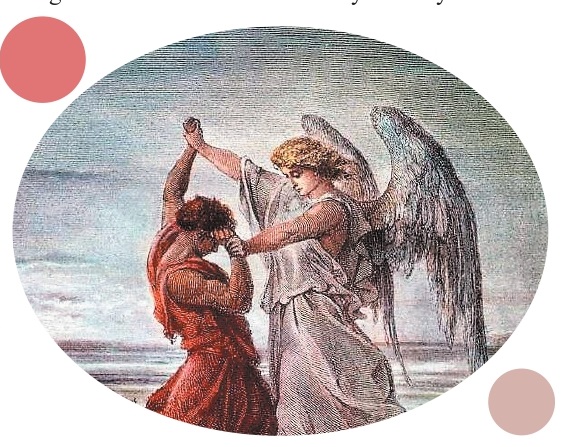
WRESTLING WITH THE ANGEL, JACOB IS DEFEATED. HIS HIP BONE GETS DISLOCATED. HE WOULD HAVE TO LIMP ALL HIS LIFETIME. FINALLY, JACOB WOULD BE IN STEP WITH GOD’S WAYS. JACOB IS BROUGHT TO RECONCILIATION WITH HIS BROTHER.
Sacrifice involves surrender: “Whatever God wills, let that be done.” Such thinking was beyond the comprehension of Jacob. He could not let go. This led him to first bargain with Esau and take away his birthright, and years later, to steal the unique blessing reserved for the firstborn. Conspiring with his mother, he deceived his father Isaac, and managed to get the blessing of the firstborn.
Isaac had prepared to bless his firstborn Esau with the graces of birthright. When Isaac realized hemade a mistake, it was too late a blessing given was given forever. Esau realising he was deceived, became furious. Jacob had to flee for his life. Rebekah directed him to go to Haran, in the care of her brother Laban. From then on, Jacob was on the run. As we look at this flight of Jacob and what he would face, it is clear when we run away from God, and His will, we also lose His protection, and we can never know where we would end up.
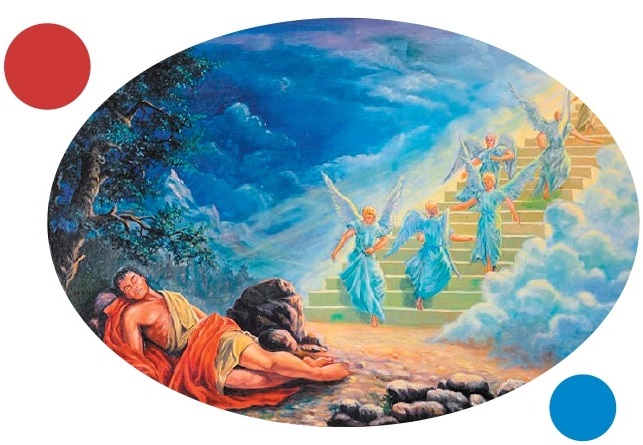
IT TOOK JACOB A LONG ARDUOUS JOURNEY TO THE ALTAR OF SELF-SURRENDER. ONLY WHEN WE SURRENDER OUR LIVES INTO THE HANDS OF GOD DO WE RECEIVE THE MANTLE OF SALVATION.
As Jacob had deceived his own, he would be deceived by Laban. When Jacob sought to marry the beautiful daughter Rachel, Laban made a contract that he must work seven years for him. He sincerely toiled for his uncle, because the face of Rachel was always there in his heart. Laban held the wedding, only for Jacob to realise on the wedding morrow that he was deceived, and given Leah, the elder daughter who was not pleasing to him. He toiled another seven years to get Rachel. Even after this, Laban would continue to harass, until Jacob would have to flee again. He had no home to return to, for what awaited him there was a furious brother. In this flight from Laban, is
his encounter with the angel of God at Penuel. Wrestling with the angel, Jacob is defeated. His hip bone gets dislocated. He would have to limp all his lifetime. Finally, Jacob would be in step with God’s ways. Jacob is brought to reconciliation with his brother. Looking at Esau, he would confess “To see your face is for me like seeing the face of God-and you have received me so kindly” (Gen 33:10).
“You shall be called by a new name that the mouth of the Lord will give” (Is 62:2)
The pilgrimage to Bethel, the altar, was a long journey. It took a long time for God to bring Jacob to sacrifice his self-will. Ultimately, God succeeds with Jacob, and directs him in the way he should go, firstly to Bethel to offer sacrifice in worship: “Go up now to Bethel. Settle there and build an altar there to the God” (Gen 35:1).
Jacob set about to offer himself as a sacrifice to God. Meticulously following the commands of God, he makes elaborate preparations. Firstly, he gets his household and the tribe to purify themselves completely, “Get rid of the foreign godsamong you; then purify yourselves and change your clothes. Let us now go up to Bethel so that I might build an altar there to the God who answered me in the day of my distress and who has been with me wherever I have gone” (Gen 35:2,3). All the idols they had acquired and the earrings which were counted as magic charms were all discarded. They donned fresh clothes, the external sign of the total transformation. The old self was removed, and the new self, put on. As Jacob makes this complete offering of himself at the altar in Bethel, God gives him a new name. “Your name is Jacob. You will no longer be named Jacob, but Israel will be your name” (Gen 35:10). This change of name signifies the total self-sacrifice, whereby there was a way now for a new identity.
After God bestows on Jacob the new name, He ratifies the Abrahamic covenant with him, “I am God Almighty; be fruitful and multiply. A nation, indeed an assembly of nations, will stem from you, and kings will issue from your loins. The land I gave to Abraham and Isaac I will give to you; and to your descendants after you I will give the land” (Gen 35:11,12).
Jacob now becomes the inheritor of the Abrahamic covenant. It took Jacob a long arduous journey to the altar of self-surrender. Only when we surrender our lives into the hands of God do we receive the mantle of salvation. It is only at Bethel, the altar of sacrifice, that Jacob enters the history of salvation. Until this time, God is the “God of Abraham, and the God of Isaac.”From Bethel, God becomes “the God of Abraham, Isaac, and Jacob.”
“The place where you stand is holy ground” (Ex 3:5)
Bethel was always holy. The first patriarch Abraham responds to the call of God, leaving his land and tribe. “Abram went as the Lord directed him” (Gen 12:4). As he passes through the land of Canaan, he receives the promise of God for him and his descendants. Here we have the first account of worship sacrifice, and this is at Bethel. “He built an altar there to the Lord and invoked the Lord by name” (v. 8). He even established a stone in honour of God.
Bethel is next mentioned as the venue where Jacob himself had a most beatific God experience. Jacob tired on his journey to Haran, stops to rest. “Then he had a dream: a stairway rested on the ground, with its top reaching to the heavens; and God’s angels were going up and down on it” (Gen 28:12). Here the Lord appears to him, saying, “I am the Lord, the God of Abraham your father and the God of Isaac; the land on which you are lying I will give to you and your descendants. Your descendants will be like the dust of the earth… In you and your descendants all the families of the earth will find blessing. I am with you and will protect you wherever you go, and bring you back to this land. I will never leave you until I have done what I promised you” (vv. 12-15). The Bible records that Jacob names this place as Bethel, because “This is nothing else but the house of God, the gateway to heaven!” (vv.16-19).
Much later, in the time of the Judges, Bethel was marked as a holy place of God’s presence. The Ark of the Covenant rested there. People went there to worship God, and to seek the counsel of God. Bethel meant the house of God, the presence of God, and the altar. The altar where.
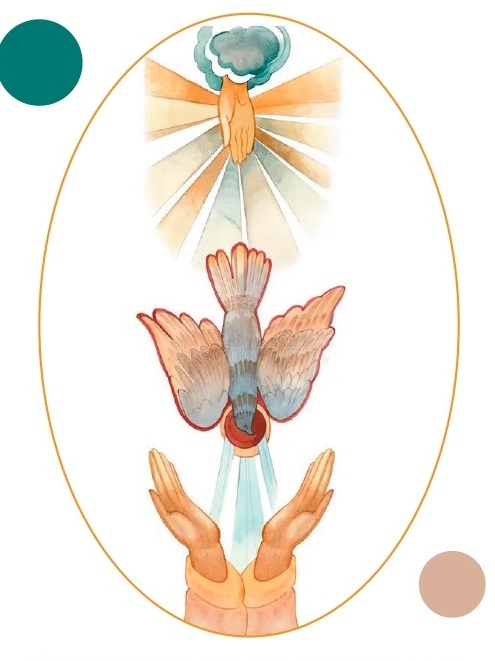
WHEN CHRIST OFFERED HIMSELF ON THE ALTAR OF HIS CROSS, FROM HIS HEART THE HOLY SPIRIT WAS POURED OUT ON HUMANKIND, FLOWING OUT AS BLOOD AND WATER. IT IS WHEN WE SURRENDER OURSELVES IN A TOTAL SELF-OFFERING TO GOD, THEN WE ARE PREPARED FOR THE FRESH ANOINTING OF THE HOLY SPIRIT. WE SHALL BE GIVEN A NEW IDENTITY, IN THE LINE OF EVERYONE CHOSEN AND BLESSED BY GOD.
beginning with Abraham, every generation of Israel offered themselves to God.That sacrifice is completed and perfected in Jesus Christ, the true Son of Abraham (Mt 1:1). When Christ offered Himself on the altar of His Cross, from His heart the Holy Spirit was poured out on humankind, flowing out as blood and water. It is when we surrender ourselves in a total self-offering to God, and we permit ourselves to be bled, our ego to be cast away, and we surrender our plans and ambitions to God, then we are prepared for the fresh anointing of the Holy Spirit. We can now be inheritors of the new covenant, the greater one. We shall be given a new identity, in the line of everyone chosen and blessed by God.
Elisha’s longing for the Holy Spirit, led him on the pilgrimage to Bethel. When we pray, we must cry out to God to lead us to Bethel, to the altar of self-surrender. It is only when we willing surrender ourselves to God that we will experience the double anointing of the Holy Spirit. Let us pray for such a generous portion of the anointing of the Holy Spirit.
Prayer
Heavenly Father, we come before you with hearts open to your divine will. Just as you prepared Elisha through the pilgrimage to Bethel, prepare us for the fresh outpouring of Your Holy Spirit. We pray for a double portion of your anointing, that we may be empowered to fulfill the mission you have entrusted to us. Help us to lay down our own plans and ambitions at your altar, to surrender completely to your will, and to receive the grace of a new and powerful anointing. Transform us with Your Spirit, and let our lives be a testament to your love and power. We ask this through Christ our Lord. Amen.
[/read]