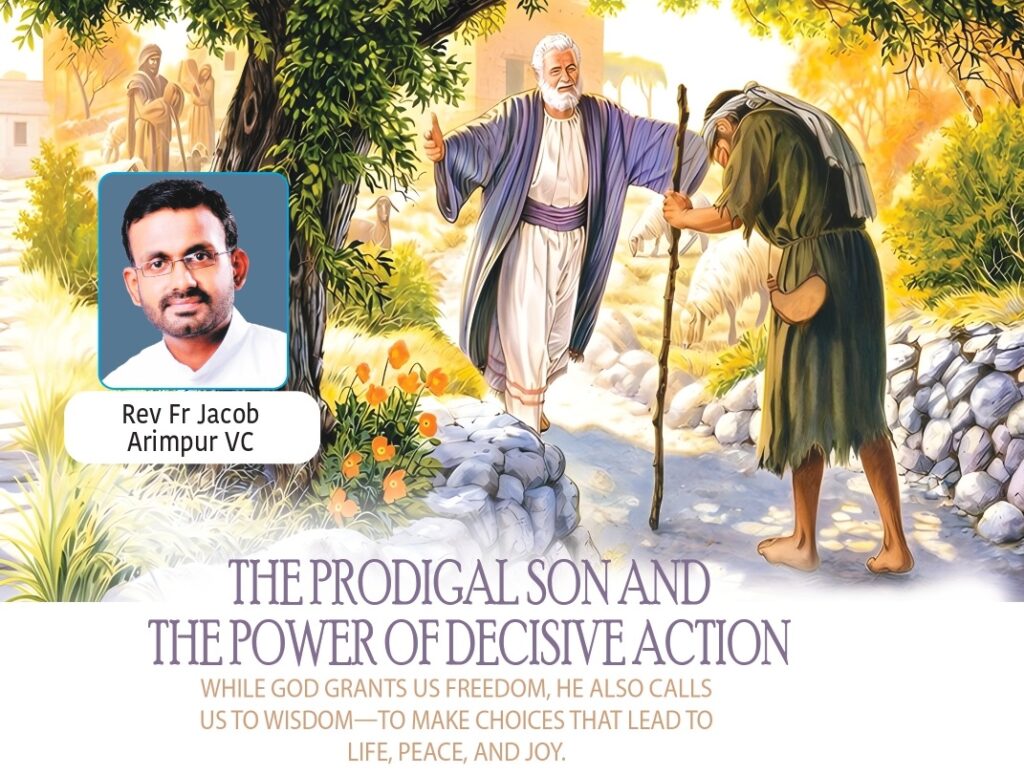
The parable of the prodigal son is one of the most familiar stories in the Gospel (Lk 15:11-32). Many of us know it by heart, yet each time we revisit it, new lessons emerge. At its core, this parable is not only about a wayward son and a forgiving father it is also about the profound power of human choice and the consequences that follow.
The Journey to the Pigsty
The prodigal son did not end up in the pigsty by accident, nor was he forced there. His misery was the result of his own decisions. He chose to leave his father’s house, demanded his share of the inheritance, and squandered it all. Eventually, he found himself feeding pigs, covered in filth, and stripped of dignity. The father never expelled him; the son walked away freely. His downfall was the natural consequence of his choices
Decisions and Consequences
Jesus uses this parable to remind us that every decision carries weight. When we lack peace, joy, or contentment, we often blame others-our circumstances, our sickness, or the people around us. Yet Scripture teaches that misery is not imposed upon us; it is embraced when we choose to dwell in negativity. Sadness, despair, and negativity do not descend upon us as unavoidable forces; they enter only when we open the door. To suffer is, in part, to consent. The human spirit is not compelled into sorrow it chooses its dwelling.
Consider the ancient story of Adam and Eve. God revealed to them the distinction between good and evil, yet He did not impose obedience. This is the essence of divine freedom: revelation without coercion, God discloses truth, but the act of choosing rests with us.
Choice, however, is never without consequence. Eve listened to the serpent, Adam followed, and together they tasted the forbidden fruit. Notice that God did not intervene, though He could have. Omnipotence does not mean interference. The Creator, who holds all power, refrained from stopping them, for freedom without responsibility is no freedom at all. Thus, the human condition is marked by this paradox: we are free to act, yet bound to the outcomes of our actions. We may deny reality, but reality will not deny us its consequences. Freedom is both gift and responsibility, a sacred trust that shapes our destiny. In this light, sorrow itself becomes a choice. To dwell in darkness or to walk toward light is not dictated by fate, nor forced by God, but decided by the will. And in that decision lies the weight and dignity of being human. God does not force us to do good, nor does He prevent us from doing wrong. He grants us freedom, but with freedom comes responsibility.
Ignoring Reality
Imagine climbing to the top of a fifteen story building and standing on the edge. If you say, “There is no gravity,” you are denying reality. Gravity is the earth’s pull-whatever goes up must come down. If you step forward off that edge, you will fall. You are free to believe there is no gravity, but you cannot escape the consequences of ignoring what is real.
In the same way, many people say there are no moral laws from God, only human rules. They choose to live however they want, ignoring what God has spoken. That is their choice, but choices always carry consequences. The prodigal son shows this clearly: the father lets him go, but he ends up in a pigsty. Freedom to choose does not mean freedom from consequences
This applies to everyday life too. If you sit inattentively, the consequence is that nothing enters your mind. If you listen carefully, you leave with understanding. Every decision brings a result. Now, what changed the prodigal son’s life? It was not just realizing he was in a filthy place. Realization alone does not change anything. The father did not come to the pigsty to rescue him. Instead, the son had to act he had to get up and walk away. Realization is God’s grace, but action is our responsibility. Change comes when we decide to move, not when we wait for circumstances or other people to change. Often, when we realize we are bitter, angry, or sorrowful, we try to fix our surroundings-our spouse, our family, our finances, our neighbors. But the prodigal son didn’t try to clean up the pigsty. He got up and left. That is the lesson: don’t wait for others to change, don’t wait for situations to improve. Get up and walk out of the place you are stuck in. Real change begins when you take that step yourself.
A Call to Decisive Action
If the prodigal son had waited for things to change on their own, he would have stayed stuck forever. If he had expected his father to come and rescue him, he would never have moved. His freedom began the moment he got up and walked back. That’s the same for us. Decisions alone don’t change our lives-action does. You can attend retreats, confess, receive the Eucharist, but if you don’t act, nothing shifts.
Sadness, anxiety, depression Jesus says: “Get up. Step out of it”. You are not trapped because of others or circumstances. You remain there because you choose to stay there. No one can make you sad or anxious unless you allow it. The truth is simple: only you can rise. Not your friends, not your family, not even God will force you. You must take the step. And the moment you do, freedom begins. Yes, sickness, financial struggles, and crises are real. But even then, the breakthrough starts when you decide to rise and walk toward the Father. The father in the parable respected his son’s freedom. He allowed him to leave, but he could not shield him from the consequences of his actions. The pigsty was not punishment from the father-it was the natural outcome of reckless living. This is the heart of the lesson: freedom is a gift, but it is inseparable from responsibility. The parable challenges us to reflect on our own decisions. If we choose distraction over attentiveness, the consequence is emptiness. If we choose bitterness over forgiveness, the consequence is unrest. If we choose to ignore God’s truth, the consequence is spiritual poverty. Every choice shapes our life, and every consequence follows naturally. The Gospel reminds us that while God grants us freedom, He also calls us to wisdom to make choices that lead to life, peace, and joy. Ultimately, the prodigal son’s story is not only about failure but also about hope. Though he faced the consequences of his decisions, he also discovered that repentance and return to the Father bring restoration. The lesson is clear: our choices matter, but so does God’s mercy
Choosing Joy amid Suffering
Life is filled with challenges illness, financial struggles, emotional burdens. Yet history and faith remind us that joy is not the absence of suffering, but the result of a conscious decision. Many saints and faithful believers have shown that even in the midst of pain, one can choose to glorify God. Consider the parable of the prodigal son. He remained in the pigsty because he chose to stay there. The moment he decided, “I will not remain here,” freedom followed. His liberation began with a decision. Saint John Paul II offers another powerful example. Throughout his life, he battled Parkinson’s disease. He was never healed of it, and he eventually died with the illness. Yet his sickness didnot prevent him from fulfilling his duties or rejoicing in the Lord. He never used his condition as an excuse. Instead, he chose to continue serving faithfully, proving that joy is not dependent on perfect health but on the will to glorify God. This truth is echoed in the lives of countless saints Padre Pio, John Vianney, Mother Teresa, Saint Thérèse of Lisieux each of whom endured immense suffering. Their pain was real, but it did not silence their praise. They decided to rejoice in the Lord despite their trials. Saint Paul, writing from prison, declared: “I can do all things through Him who strengthens me.” He did not mean that God would miraculously release him from prison. Rather, he meant that even in chains, even in hunger, even in discomfort, he could still rejoice. His joy was a decision, not a product of circumstance. This challenges a growing tendency today: the belief that only when problems vanish-when sickness is healed, finances improve, or burdens lift can one rejoice in God. That is a deception. True joy is not conditional. It is a choice. The moment we decide to rejoice, no one and nothing can take it away. Scripture reinforces this hope. The prophet Micah proclaims: “He will again have compassion upon us; He will tread our iniquities underfoot. You will cast all our sins into the depths of the sea.” God’s mercy is infinite, yet our time to receive it is limited. We are finite beings; one day, life will end. Mercy is not something to only hear about-it must be received. That is why the present moment is so critical. Now is the time to act, to embrace God’s mercy, and to choose joy. If I rise, respond, and embrace it, I will truly experience the fullness of His mercy. Joy is not the absence of struggle it is the victory of faith over struggle.